Sunday, November 13, 2011

Chao Mendoza

After ten weeks in wonderful Mendoza we said good-bye and packed our bags for Salta, Argentina. We had mixed feelings. We were ready for the next part of our adventure but sad to leave new friends. We met so many wonderful people in Mendoza - Nike Running Team who sincerely welcomed us, Mercedes & Javier from B&B Italia, Melina - my Spanish teacher, friends from our Spanish classes.
Melina, my friend and a great teacher, is to my left. 
Before we left, our friend Carlos invited us to his house for dinner with his wife and daughter. We met Carlos in the running group early on and he and John hit it off right away.

Carlos' wife, Veronica,  cooked a wonderful dinner - homemade chicken milanesa, a fantastic carrot and apple salad, mashed potatoes, and, of course, wine.  Dessert was dulce de leche and banana pudding followed by a glass of fernet and coke. The food was incredible and we had fun visiting with Carlos and his family. His daughter is ten years old, and I was able to practice my spanish.  We talked about dolls, the color pink, field hockey and Disneyland.


Our last Saturday in Medoza, the running group had plans to run in San Rafael, about an hour and a half from Mendoza, and then have an asado. We carpooled to San Rafael, and after a dropping off our clothes to change into and taking a few group photos, the team drove to the start about two miles away. Thanks to Turco, our coach, who toted John and I around to more than one asado during our time in Mendoza!  We ran 18km on dirt roads with the mountains on one side and farms and vineyards on the other.

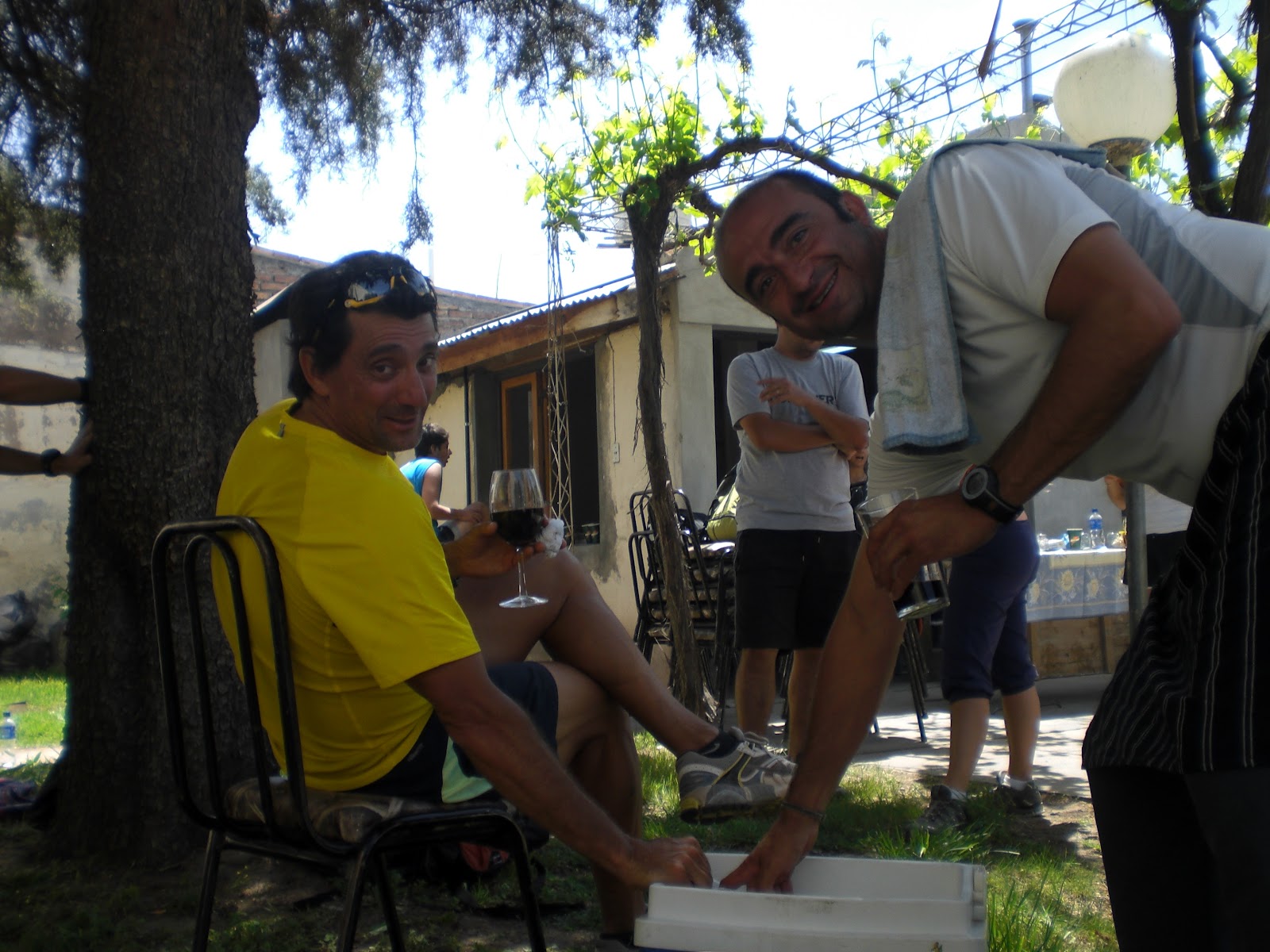
By the time we made it back to the asado, we were ready to clean up and eat. Turco brought a bottle of wine to share with John and me, so we shared a toast and drank wine to recover from our long run. I could get used to this!
Coaches Turco y Martin
The asado was in a yard with a huge kitchen and dining area behind a bank. The wife of the bank's manager runs with the group, and they hosted us. Friends gathering to enjoy conversation and food - that's the heart of an asado. There is always an asador who grills the meat and watches the fire. People  bring their own plates, cups and silverware, so there is no plastic waste, and the host doesn't spend money on disposable table wear. It is brilliant.
Some folks bring this set-up while others bring a plate/cutlery from their kitchen. This is pretty fantastic, though. 
Asados seem like a big production but everyone works together to make it easy, so the host(ess) doesn't have to do everything. It seems like there is more emphasis on everyone visiting and being together than guests being waited on, so to speak. People bring overflowing bags of bread and produce they buy from the roadside stands, and minutes before the meat is ready, they throw together wonderful salads tossed with vinegar and olive oil.

I love the big salads - lettuce, tomatoes, avocados, carrots. I will confess that John and I brought a huge bag of potato chips and it was barely touched. In addition to the salads and bread, there are open bottles of wine and coke on the table. Everyone helps themselves. The asador periodically walks around with a cutting board full of new cuts of meat and the guests select which piece they want. People don't pile their plates with food from the beginning, instead, people eat bit by bit - a little meat, a little salad, a roll, repeat the cycle a few times as the asador comes around and then you're full.

Martin, el asador
After a few hours, we said our goodbyes and thank-you's, and returned to Mendoza to finish packing. Sad to say good-bye but also excited for the next part of our journey!

Saturday, October 29, 2011

Mr. Savage visits Argentina

John's dad came to visit us in Argentina. We had a great time showing him around Mendoza, and we took a road trip west toward the Andes. See the pictures here! 


Monday, October 3, 2011

Wine Tour! Wine Tour!

After more than two months in the wine capital of South America, John, his dad and I went on a wine tour. Our friend and wine tour guide, Javier, picked us up at 9am in his French-designed, Brazilian-made tan Citroën and off we drove to Maipu, a wine producing town ten minutes south of Mendoza.

I didn't have any expectations for the day besides seeing some viñedos (vineyards) and bodegas (wineries) and tasting wine. I was mostly looking forward to getting out of the city and doing something different than my daily school-lunch-nap-study-exercise routine.

Our first stop was CarineE vineyards. Named after a southern hemisphere constellation, Carina, this is a small vineyard and winery that produces 75,000 bottles per year and is owned by a French couple who settled here after coming to Argentina for work.  After a short tour of the winery and the history of the vineyard, we tasted five wines. By this time it was about 10:30am, and I quickly learned that I could, and should, only tolerate a few sips of each.
The woman on the far right labels and packs all the bottles by hand at CarinaE.
Our next stop was Domaine St. Diego, another small vineyard and winery producing 35, 000 bottles annually, sold only from the vineyard. When we drove up a gray haired man was waiting at the gate to recycle his damajuana, a huge jug for wine, and get a new one - an errand he and many other locals repeat weekly.

Domaine St. Diego is a small family owned and operated business. The daughter in the family, who is the main tour guide and graphic designer for the bottle labels, gave us a thorough tour of the vineyard and explained how the vines grow, and how they propagate new vines when the older ones become tired.
grapevines and olive trees

acequia - canal that carries water from the mountains throughout the region
A passion for quality wine and sustainable growth is evident throughout the vineyard. At the entrance to the vineyard a few rose bushes are used to signal possible issues with the grapevines - if the rose bushes are suffering, then the grapevines are suffering, too.  Olive trees stand between rows of vines and are used for shade and olive oil.  Lavender plants lure ants away from the vines while also attracting bees for pollination. They use byproducts from the wine (grape seeds, skins and stems) and olive oil (olive seeds and skins) production to make compost that is used throughout the vineyard.  A system of small canals, called acequias, carry water from the mountains that the family uses to irrigate the vineyard. 

About half-way through this tour, somewhere between the olive trees and the acequia, I fell in love with this vineyard and the operation. Everything is clearly cyclical and intentional. When we asked how it was to work with the family, she told us they have a family asado every Sunday at the vineyard.
site of the family asado, or BBQ, held every Sunday
After the tour, we tasted three wines and olive oil. We bought a bottle of Pura Sangre Malbec that I look forward to sharing with John for our one-year anniversary later this month.


At this point we had learned a significant amount about the wine growing and production processes, and we were hungry. Our next stop was the Bodega Ruca Malen, where we were pleasantly surprised with a five course lunch with wine pairing and a stunning view.
view from dining room


For the foodies out there, we were served:
1.  Yellow Andean potatoes with sour cream, lemon zest, ham strands and olive oil paired with a Chardonnay.
2.  Fresh ricotta and sauteed onion rolls with a Malbec and balsamic vinegar sauce paired with a Cabernet Sauvignon.
3.  Traditional lentil stew with country sausages braised in Merlot wine paired with a Merlot.
4.  Beef tenderloin with....who cares, right? It was great. Paired with a Cabernet Sauvignon and then a Malbec.

5.  A Bavarian cream dessert on a biscuit paired with a sparkling Brut made from 75% Pinot Noir + 25% Chardonnay. 


John Sr., Javier, John
Of course we were ready for a nap after lunch, but we had one more stop to make. With a wink, Javier told us the next stop was for his preferred clients, and we drove to the winery of Carmelo Patti. Carmelo was born in Italy and moved to Argentina when he was very young.  His grandfather made wine, and Carmelo continues the tradition.  He buys grapes from a neighbor and produces 15,000 bottles of wine annually.

We went straight to the tasting, which was great, but I was more interested in Carmelo.  With a huge smile he energetically showed us magazine articles and newspaper clippings about his winery and talked about his wine.  It didn't matter that he was speaking in Spanish, and I couldn't understand every word.  Carmelo Patti's enthusiasm is infectious, and I clearly understood that he loves making wine.
notice the magazine and newspaper clippings in plastic covers on the right
The Savages with Carmelo Patti

Tuesday, September 6, 2011

Comida/Food

If you asked me my ten favorite things, five of those things would center around food: cooking healthy food, grocery shopping, drinking coffee and wine, talking about how food can change your life.  Hence the reason I want to share our food experience with you. I love whole foods - vegetables, grains and fruits.  I also enjoy a good tortilla or scoop of gelato - I can't help it. The past eight months, John and I have enjoyed fresh vegetable made-at-home green juices everyday. (I'm a huge Kris Carr fan who is a champion of the green juice.)

I came to South America with packets of Field of Greens Raw Food to meet my daily vegetable needs and to keep my pH in check. I also looked forward to eating standard Argentine cuisine - steak and wine.  We ate out the first two weeks we were here, and I met my steak threshold quickly.  I've since returned to a mostly vegetarian diet.

Before we arrived, I had quaint notions of life in Mendoza - sitting on our porch, sipping coffee, gazing at the mountains and vineyards. Well ... I can sort of see the top of the mountains from our balcony. And the vineyards... we're going on a wine tour later this month. Another notion was buying bread from a bakery, meat from a butcher, and vegetables from a small market.   The day we moved into our apartment, our landlord pointed out a large supermarket two blocks away, which we went to the same day.  So much for buying groceries at small mom and pop shops.

Every night we walk home from our workout at the park, and it has become one of my favorite routines - walking home, endorphins flowing after a run, talking about life or what we're going to have for dinner. As we walked home from the park last Tuesday, we couldn't resist the aroma of bread and sweets from a bakery we pass every night.  We gave in and bought some bread and cookies, and wondered why we hadn't been buying bread at the bakery all along.  Since our Tuesday night epiphany, we've purchased all our food from small shops, and we haven't been back to the big supermarket again.

Lining the major street near our apartment are several small stores that sell produce and other items.  My favorite is Verduleria y Fruteria Selena. The shop receives produce daily from a cooperative about 15 kilometers away.  I love shopping there. I can buy two big bags of produce for $5. The other day the total was $4.80, and the young man working there threw in another orange to make it an even $5.

Overview of what & where we've been eating
Week #1: Santiago & Mendoza
Coffee, pasta, a steak for John, one vegetarian restaurant, bread, limited vegetables.

Week #2: Mendoza
Cafe con leche & toast, happily located a few vegetarian restaurants and a salad bar, another steak, more coffee, empanadas, but still no kale, avocado, tortillas or broccoli. A wonderful dinner of thick lentil soup, bread and wine at a friend's house.

Week 3: Apartment in Mendoza
Cafe, oatmeal. Big pot of black beans and brown rice for me; arroz con pollo for John. Enjoyed a traditional asado (BBQ) with the running group.

Week 4:
More cafe, fruit and oatmeal. John makes breakfast tacos so he won't starve while in class from 9 -1. Huge lunches of rice, beans and spinach with tortillas, which I finally found in the market.  Wine and salad with steamed broccoli for dinner. Discovered dulce de leche. Uh oh. 
Traditional asado - note the huge built-in grill. People bring their own plates + utensils, some of which were brought in specially-made leather carrying cases. 
We thought this would last us the whole three months we'll be here. It lasted a week! It sort of takes the place of almond or peanut butter which is not sold in stores.

Wednesday, August 24, 2011

Apartment #8

We woke up last Monday a bit sore from the half-marathon but energized by the notion of moving into our apartment! When we went down for our last breakfast at the B&B, sweet Mercedes told John that she wanted to take us (and all of our stuff) to our new apartment.  She drove us to meet the landlord, Senor Padilla, to pay rent and get the keys. She was so sweet and we were sad to say good-bye! 


The apartment is about a 10 minute walk from our school, 15 minutes from the park and one block from the supermarket which doubles as a mini-walmart. (They have everything!)
Yes, it's as small as it looks! It's cozy: a dining space, living room, bathroom, bedroom and kitchen. We've made ourselves at home and will be here for the next three months. 


I was excited to cook and not have to eat out.  Even though we found a few vegetarian restaurants, I was so tired of eating out! Please, no more steak, chimichurri and white bread. 


First things first: tacos!


I've been craving tortillas and salsa like you wouldn't believe. I haven't found a store that sells tortillas, so I bought flour, baking power, salt and butter.  While I did have a recipe from the internet, I did not have one accurate measuring device, but that didn't stop me. I simply channeled my inner Diana Kennedy and got down to business... 

Tacos y salsa! 

Monday, August 22, 2011

La Media Maraton

I have run several half marathons, but none quite like the Maraton Internacional Mendoza, which John and I ran last Sunday.


We woke up at 6:00am to eat a bit and catch a bus to the starting line. The last bus was scheduled to leave at 7:00, so at 6:56, when we were still in route to catch the bus, I worried we may miss it. No need to worry, the bus didn't leave until 7:30. We arrived at the starting line just before 8:00am, an hour before the race was scheduled to start. On the way, John repeated something our coach said, "don't be late. The race starts at 9:00, so make sure you're there by 9:10, 9:20 at the latest."  Welcome to South American time.


When we arrived to the starting line, it was about 30 degrees and still dark outside.  We stayed on the bus to keep warm.  Most runners got off the bus, ran around and warmed up for the race. Several runners started a brush fire on the side of the road to keep warm. Think: dry winter morning, rural road, a few hundred people milling around. John and I laughed and then laughed harder when we saw people pulling huge, dry tumbleweeds to add to the fire.  This would not happen in the U.S.! I tell you what, though, when we finally deboarded the bus at 8:50 that fire felt good! 


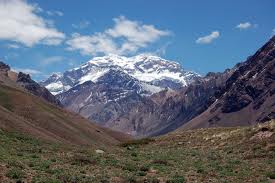
Just after 9:00 the gun went off.  John and I were walking toward the starting line not worrying too much about our running performance. We told ourselves to enjoy the run and the scenery.  The sun had risen, illuminating vineyards on either side of the road and the snow-covered Andes in the distance, including Mount Aconcagua, the highest point in South America.  The race route snaked through fields, rolling hills and a few small towns.  As we approached Mendoza, the smell of diesel replaced the fresh mountain air, and we passed a couple of desperately poor neigborhoods - what I would call shantytowns.
Before I knew it, I only had six miles remaining. I felt great, which was surprising because  three days prior I was laid out in bed with food poisoning. Since John finished before me, he cheered me on as I neared the finish line. I ran a 1:45 and felt strong the whole time. It was a lot of fun! 
Tiny picture (from facebook) of some of the Nike Mendoza Running Team. John & I are far right. 

Friday, August 19, 2011

First Day of Class

Last night I woke up at 2am worried we might die from a gas leak.  


Houses in Mendoza are heated with small gas heaters. No central heat and air here. Before going to sleep I turned off the small wall heater in our room and didn't think twice about it.  
Until 2am.
I wasn't sure if the gas needed to be turned off at the wall like I had to do when I lived in a 1920's Austin bungalow. And I wasn't sure if the egg-smelling sulfer compound is added to natural gas in Argentina.  What a perfect story from South America: American Couple's room catches fire after gas is left on! John was asleep and I didn't want to wake him in case I was over-thinking the situation.


I opened a window so we wouldn't pass out if carbon monoxide or gas filled the room. After ten more minutes of worrying, I woke John up and told him I was concerned about the gas valve. He didn't seemed too worried, but bless his heart - he got up, took a look and then went downstairs to ask the B&B employee. Since we couldn't find anyone, he got on the computer and attempted to google us out of this quandry to no avail. 


As precautionary measures, we opened the window and door and closed the gas valve in our room, before going back to bed at 3am. We were so exhausted, we slept better then we have since we arrived. 


The next morning the B&B owner assured us we had nothing to worry about, and that the gas shut off when I turned the heater off. John and I laughed about the situation.  Unfortunately we started spanish class on four hours of sleep.


I was looking forward to starting spanish class. After a week of trying to speak it, I realized how little I know and how little I can say.  Here's what I know after 3 days of 4-hour classes: learning Spanish is hard! I didn't realize how many different verb tenses there are, and my ignorance was bliss. My class level is too advanced for me, and I struggle to keep my head above water. I sit wide-eyed, listen to the teacher, and try to make sense of her words.  Although frustrated, I remain patient and motivated. 
in front of our language school
Update: I switched to a beginner-level class and am very happy!  The teacher reviews things I already know, and I can actually participate.
(from nataliedee.com)